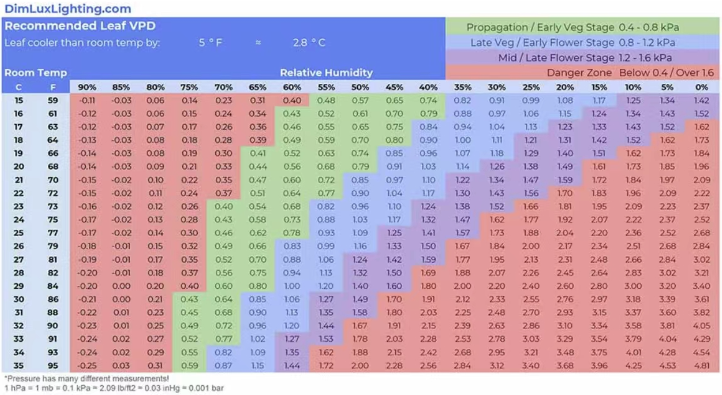
A VPD chart makes this relationship easier to understand by showing how temperature, relative humidity (RH), and VPD interact.
As a general starting point, many indoor growers use lower VPD ranges for seedlings and clones and gradually increase VPD as plants mature. However, there is no single VPD number that works for every plant or growing environment. Your target should be treated as a range and adjusted based on plant stage, temperature, humidity, and leaf temperature.
Quick Answer: What VPD Should You Aim For?
A commonly used starting range for indoor growing is:
| Growth Stage | Suggested VPD Range | General Goal |
|---|---|---|
| Seedlings & Clones | 0.4–0.8 kPa | Reduce stress while roots establish |
| Early Vegetative | 0.8–1.0 kPa | Support steady vegetative growth |
| Late Vegetative | 1.0–1.2 kPa | Encourage active transpiration and growth |
| Early Flowering | 1.0–1.3 kPa | Support the transition into flowering |
| Mid/Late Flowering | 1.2–1.5 kPa | Maintain controlled transpiration |
These ranges are starting points, not fixed rules. Different plant species, cultivars, growing systems, temperatures, and lighting conditions can require different targets.
VPD is affected by both temperature and humidity. If either changes, VPD changes as well.
What Is VPD?
VPD stands for Vapor Pressure Deficit.
It describes the difference between how much moisture the air can hold at a given temperature and how much water vapor is actually present.
VPD is measured in kilopascals (kPa).
In simple terms:
VPD indicates how strongly the surrounding air can draw moisture from a plant.
A higher VPD means the air is relatively dry and has a greater capacity to take up water vapor from the plant. A lower VPD means the air is closer to saturation and creates less evaporative demand.
This makes VPD useful because temperature and relative humidity should not be considered completely independently. For example, 60% RH at 70°F does not create the same VPD as 60% RH at 80°F because warmer air can hold more moisture.
Why Does VPD Matter for Indoor Growing?
Plants continuously exchange water vapor with the surrounding air through their stomata.
When VPD is within a suitable range, transpiration can proceed at a useful rate. This supports water movement through the plant and helps maintain normal physiological processes.
However, extremes can create problems:
- Very low VPD: The air is highly humid, reducing evaporative demand and potentially slowing transpiration.
- Very high VPD: The air is very dry relative to the plant, increasing water loss and potentially causing plant stress.
- Stable VPD: Gives you a more consistent way to monitor the relationship between temperature and humidity.
VPD therefore works best as one part of an overall environmental management strategy rather than as a replacement for temperature, RH, airflow, or other measurements.
VPD Chart for Grow Tents
A VPD chart connects three key variables:
- Temperature
- Relative humidity (RH)
- VPD
To use a chart, find your grow tent's temperature and relative humidity, then locate the corresponding VPD value.
Example
Suppose your grow tent is:
- 75°F
- 60% RH
The corresponding VPD is approximately 1.0 kPa under an air-temperature-based calculation.
You can then compare that value with the target range for your plant's current growth stage.
The important point is that you should consider temperature and humidity together, rather than trying to maintain RH at a particular number without considering temperature.
Simplified Air VPD Reference
The following examples show approximately how temperature and RH interact:
| Temperature | Relative Humidity | Approx. Air VPD |
|---|---|---|
| 70°F | 70% | 0.7 kPa |
| 75°F | 70% | 0.8 kPa |
| 80°F | 70% | 1.0 kPa |
| 75°F | 60% | 1.1 kPa |
| 80°F | 60% | 1.3 kPa |
| 85°F | 60% | 1.5 kPa |
| 75°F | 50% | 1.4 kPa |
| 80°F | 50% | 1.7 kPa |
Values are approximate and based on air temperature. Actual leaf VPD can differ because leaf temperature may differ from air temperature.
How to Read a VPD Chart
Follow these steps:
- Identify your plant's growth stage.
- Measure the temperature at or near the plant canopy.
- Measure relative humidity at the same location.
- Find the temperature and RH combination on the VPD chart.
- Compare the resulting VPD with your target range.
- Adjust temperature or humidity if conditions consistently fall outside your target.
A VPD chart is a reference tool. You do not need to keep your environment at one exact decimal value.
Ideal VPD by Growth Stage
VPD targets generally change as plants develop.
Young plants are more sensitive to excessive evaporative demand, while established plants can generally tolerate higher VPD.
Seedlings and Clones: 0.4–0.8 kPa
Seedlings and clones typically benefit from a lower VPD range while their root systems are developing.
A lower VPD reduces evaporative demand and can help prevent excessive water loss during early development.
General target: 0.4–0.8 kPa
Focus on:
- Consistent temperature
- Moderate-to-high humidity
- Gentle airflow
- Avoiding rapid environmental changes
Do not assume that raising VPD as quickly as possible will accelerate growth. Young plants may not have the root system necessary to support high evaporative demand.
Early Vegetative Growth: 0.8–1.0 kPa
As plants develop stronger roots and larger leaves, they can generally tolerate a higher VPD.
General target: 0.8–1.0 kPa
At this stage, monitor:
- Canopy temperature
- Relative humidity
- Air movement
- Plant response
- Growth rate
Late Vegetative Growth: 1.0–1.2 kPa
Established vegetative plants can generally operate at a somewhat higher VPD.
General target: 1.0–1.2 kPa
The goal is not simply to increase VPD. Instead, look for a stable environment where plants can transpire without experiencing excessive water loss.
Early Flowering: 1.0–1.3 kPa
During the transition into flowering, growers often begin moving toward a higher VPD range.
General target: 1.0–1.3 kPa
Temperature and humidity can fluctuate more significantly during this stage because plant size, lighting intensity, and transpiration are increasing.
Mid-to-Late Flowering: 1.2–1.5 kPa
Mature flowering plants can often tolerate a higher VPD than seedlings.
General target: 1.2–1.5 kPa
However, avoiding excessive humidity becomes increasingly important in dense canopies and flowering environments.
These ranges should be treated as practical starting points rather than universal requirements. Published VPD charts vary in their recommended ranges and whether they are based on air VPD or leaf VPD, so growers should use the underlying environmental conditions and plant response when making adjustments.
Air VPD vs. Leaf VPD
One important distinction is whether your VPD calculation uses air temperature or leaf temperature.
What Is Air VPD?
Air VPD uses:
- Air temperature
- Relative humidity
It is simple to measure and useful for monitoring the general environment inside a grow tent.
What Is Leaf VPD?
Leaf VPD takes leaf temperature into account.
The temperature of a plant's leaves can differ from the surrounding air. Transpiration can cool the leaf surface, so leaf temperature may be lower than air temperature under some conditions.
A leaf-VPD calculation therefore provides additional information about the conditions experienced directly at the plant.
Some modern VPD calculators and environmental controllers specifically incorporate leaf temperature rather than relying only on room temperature.
Which One Should You Use?
For basic environmental monitoring, air VPD is easier to measure and can be useful for tracking trends.
For more precise plant-level monitoring, leaf VPD can provide additional information, particularly when leaf and air temperatures differ significantly.
If you use leaf VPD, measure leaf temperature consistently and use a calculator or system designed for leaf-temperature-based VPD.
How Temperature and Humidity Affect VPD
VPD changes when temperature or humidity changes.
Higher Temperature Usually Means Higher VPD
As temperature increases, air can hold more water vapor.
If RH stays the same while temperature rises, VPD generally increases.
For example:
75°F + 60% RH
and
85°F + 60% RH
do not produce the same VPD.
This is why maintaining a specific RH percentage without considering temperature can be misleading.
Higher Humidity Usually Means Lower VPD
If temperature stays constant and RH increases, VPD decreases.
For example:
Increasing RH from 50% to 70% at the same temperature lowers VPD.
Why the Same RH Can Mean Different Things
Consider two grow tents:
| Tent A | Tent B |
|---|---|
| * 70°F | * 85°F |
| * 60% RH | * 60% RH |
Both tents have the same RH, but the warmer tent has a higher VPD.
This is one of the main reasons growers use VPD instead of looking at humidity alone.
How to Calculate VPD
The basic relationship is:
VPD = Saturation Vapor Pressure − Actual Vapor Pressure
Where:
- Saturation Vapor Pressure (SVP) represents the maximum water vapor pressure possible at a given temperature.
- Actual Vapor Pressure (AVP) represents the amount of water vapor currently present in the air.
Because the calculation involves temperature-dependent vapor pressure, most growers do not need to calculate VPD manually.
A VPD chart or calculator can convert temperature and RH into a VPD value much faster.
How to Measure VPD in a Grow Tent
For practical monitoring:
- Place a temperature and humidity sensor near the plant canopy.
- Avoid placing the sensor directly in front of an exhaust outlet or humidifier.
- Record temperature and RH.
- Use a VPD chart or calculator.
- Compare the reading with the target range for the current growth stage.
- Monitor trends instead of reacting to every small fluctuation.
What Happens When VPD Is Too Low?
A very low VPD means the air is highly humid relative to the temperature.
This creates lower evaporative demand.
Potential concerns include:
- Reduced transpiration
- Slower drying of leaf surfaces
- Excessively humid canopy conditions
- Greater difficulty controlling moisture in dense plant growth
Low VPD is not automatically harmful. Young plants and clones may intentionally be grown at lower VPD levels.
The concern is when VPD remains unnecessarily low for a mature plant or when high humidity creates an unfavorable environment.
How to Increase Low VPD
If VPD is consistently too low, you can consider:
- Lowering relative humidity
- Increasing temperature within an appropriate range
- Improving air circulation
- Increasing ventilation when appropriate
- Using a dehumidifier if humidity remains high
Make one adjustment at a time when possible so you can understand how the environment responds.
What Happens When VPD Is Too High?
High VPD means the air has a strong capacity to take up moisture from the plant.
If the plant cannot replace water quickly enough, excessive VPD can contribute to water stress.
Potential signs include:
- Leaf curling
- Wilting
- Dry leaf edges or tips
- Reduced growth
- Stomatal closure
- Increased water demand
High VPD can become especially challenging when temperature is already high and plants are under intense light.
How to Lower High VPD
If VPD is consistently too high, you can consider:
- Increasing relative humidity
- Lowering temperature within an appropriate range
- Adjusting light intensity if heat is contributing to the problem
- Improving environmental control
- Checking whether your ventilation system is removing excessive moisture
Avoid increasing humidity blindly. The goal is to bring the environment into a suitable range, not simply maximize RH.
How to Maintain VPD in a Grow Tent
Maintaining VPD requires managing the factors that influence it.
1. Measure Conditions at Canopy Level
The environment near the plant canopy can differ from the air near the floor, ceiling, intake, or exhaust.
Place environmental sensors where they represent the conditions your plants are actually experiencing.
Avoid placing sensors:
- Directly under an exhaust outlet
- Immediately beside a humidifier
- Against the tent wall
- In a location exposed to direct water spray
2. Use Circulation Fans
Circulation fans help distribute air throughout the grow tent.
Good airflow can help reduce localized temperature and humidity differences around the canopy.
However, airflow should not be treated as a direct replacement for temperature or humidity control.
3. Use Exhaust Ventilation
An inline exhaust fan can remove:
- Excess heat
- Moist air
- Stale air
Ventilation can therefore affect both temperature and humidity, which in turn changes VPD.
4. Use a Humidifier or Dehumidifier When Necessary
If your environment is consistently too dry, a humidifier can raise RH and lower VPD.
If your environment is consistently too humid, a dehumidifier can lower RH and increase VPD.
The appropriate solution depends on the direction of the problem.
5. Monitor Day and Night Conditions Separately
VPD can change when lights turn on or off.
For example:
- Lights on → temperature may increase
- Lights off → temperature may decrease
- RH may rise as temperature falls
Because VPD depends on both temperature and humidity, the same RH percentage can produce different VPD values at different times of day.
Instead of checking VPD only once, monitor how it changes throughout the light cycle.
VPD vs. Relative Humidity: Which Should You Monitor?
VPD and RH answer different questions.
Relative humidity tells you how much moisture is in the air relative to the maximum amount the air can hold at that temperature.
VPD adds temperature to that relationship and helps describe the evaporative demand surrounding the plant.
That means RH remains an important environmental measurement.
VPD should be viewed as an additional metric rather than a replacement for RH.
A practical grow-tent monitoring system can track:
- Temperature
- Relative humidity
- VPD
- Leaf temperature when available
- Day/night changes
- Plant response
This gives you more context than relying on any single number.
Common VPD Mistakes
Mistake 1: Focusing Only on RH
Keeping RH at 60% does not guarantee the same VPD under every temperature.
Always consider temperature and RH together.
Mistake 2: Chasing One Exact VPD Number
A VPD target should generally be treated as a range.
Small fluctuations are normal.
The goal is a stable environment rather than constantly adjusting equipment to move from 1.0 to 1.1 kPa.
Recent VPD guidance from indoor-growing sources similarly emphasizes using ranges and monitoring trends instead of chasing a single exact value.
Mistake 3: Ignoring Leaf Temperature
Air temperature and leaf temperature are not always identical.
If you are using leaf VPD, make sure you are measuring or estimating leaf temperature appropriately.
Mistake 4: Measuring in the Wrong Location
A sensor beside an exhaust fan may not represent the temperature and humidity around the canopy.
Measure where the plants actually grow.
Mistake 5: Making Constant Adjustments
Environmental conditions naturally fluctuate.
Before changing equipment settings, determine whether the VPD is consistently outside your target range or only temporarily fluctuating.
Mistake 6: Ignoring Day/Night Changes
Your VPD can change substantially when temperature and RH change after lights turn on or off.
Monitor the full light cycle rather than relying on a single measurement.
A Simple VPD Troubleshooting Guide
| Problem | Possible Cause | What to Check | Possible Adjustment |
|---|---|---|---|
| VPD too low | RH too high | Humidity and canopy airflow | Reduce RH or increase temperature appropriately |
| VPD too high | RH too low | Humidity and temperature | Increase RH or lower temperature appropriately |
| VPD changes rapidly | Temperature or RH fluctuates | Day/night conditions | Stabilize environmental controls |
| Sensor shows unusual readings | Poor sensor placement | Sensor location | Move sensor closer to canopy |
| VPD looks acceptable but plants show stress | Other environmental factors | Light, roots, airflow, temperature, watering | Evaluate the entire growing environment |
| Different sensors show different VPD | Different locations or measurement methods | Sensor placement and calculation method | Standardize measurement location |
VPD should not be used as the only diagnostic tool. If plants show stress while VPD appears appropriate, investigate other environmental and growing conditions as well.
How to Monitor VPD More Consistently
For a simple setup, you need:
- Temperature sensor
- Relative humidity sensor
- VPD chart or calculator
For more advanced monitoring, you can add:
- Leaf temperature measurement
- Smart environmental controller
- Automated ventilation
- Humidifier
- Dehumidifier
- Heater or air conditioner
- Data logging
Some modern grow controllers can monitor VPD and use high- or low-VPD thresholds to trigger connected equipment.
The advantage of automation is not that you have to maintain one perfect number. Instead, it can help keep environmental conditions within a desired range as temperature and humidity change.
VPD and Grow Tent Equipment
Because VPD depends heavily on temperature and humidity, your environmental equipment works together as a system.
Grow Lights
Grow lights can increase canopy temperature.
If your lights raise the temperature significantly, VPD may increase even when RH remains unchanged.
Inline Fans
Exhaust fans can remove heat and moisture from the grow tent.
Fan speed therefore affects the environmental conditions used to calculate VPD.
Circulation Fans
Circulation fans distribute air and reduce stagnant areas within the canopy.
Humidifiers
Humidifiers increase RH and generally decrease VPD.
Dehumidifiers
Dehumidifiers reduce RH and generally increase VPD.
Smart Controllers
A smart controller can combine sensor readings with equipment controls to help automate environmental management.
This is particularly useful when temperature and humidity fluctuate throughout the day.
Frequently Asked Questions About VPD
What is a good VPD for seedlings?
A common starting range is 0.4–0.8 kPa for seedlings and clones. Younger plants generally benefit from lower evaporative demand while their root systems are developing.
What is a good VPD for vegetative growth?
A common starting range is approximately 0.8–1.2 kPa during vegetative growth. You can gradually increase VPD as plants become more established.
What is a good VPD for flowering?
A common starting range is approximately 1.0–1.5 kPa, depending on the stage of flowering and the plant's environmental conditions.
Different VPD charts use different ranges, particularly when comparing air VPD with leaf VPD, so use these values as starting points rather than absolute targets.
What happens if VPD is too high?
High VPD increases evaporative demand. If the plant cannot replace water quickly enough, it can experience water stress, including wilting, leaf curling, or reduced growth.
What happens if VPD is too low?
Low VPD reduces evaporative demand and can slow transpiration. Persistently high humidity can also make moisture management more difficult, particularly in dense plant canopies.
How do I lower VPD in a grow tent?
You can generally lower VPD by:
- Increasing RH
- Lowering temperature
- Reducing excessive heat
- Improving environmental stability
Make sure the resulting humidity remains appropriate for your plants and growth stage.
How do I increase VPD in a grow tent?
You can generally increase VPD by:
- Lowering RH
- Increasing temperature within a suitable range
- Improving ventilation when appropriate
Avoid raising VPD simply by increasing temperature if the plants are already experiencing heat stress.
Is VPD more important than humidity?
No. VPD and RH provide different information.
RH is still an important measurement, while VPD combines temperature and humidity to provide additional context about evaporative demand.
Should I use air temperature or leaf temperature for VPD?
Air temperature is easier to measure and can be useful for general environmental monitoring.
Leaf temperature can provide more plant-level information because leaves may be warmer or cooler than the surrounding air.
If you want to use leaf VPD, measure leaf temperature consistently and use a calculator designed for it.
Does VPD change at night?
Yes.
When lights turn off, temperature and humidity often change. Because VPD depends on both variables, your VPD can change even if your humidity setting remains the same.
What temperature and humidity give you a 1.0 kPa VPD?
There are multiple temperature/RH combinations that can produce approximately 1.0 kPa VPD.
For example, a grow environment around 75°F and 60% RH produces approximately 1.0 kPa air VPD.
Use a VPD chart or calculator for your exact temperature and RH combination.
Can I use VPD for every type of plant?
VPD can be useful for many indoor-growing environments, but the appropriate range depends on plant species, growth stage, cultivar, temperature, light intensity, and other conditions.
Use VPD as one environmental indicator rather than a universal rule.
Final Takeaway
VPD provides a practical way to understand how temperature and humidity work together inside a grow tent.
Instead of monitoring RH alone:
- Measure temperature and relative humidity.
- Use a VPD chart or calculator to determine your current VPD.
- Compare it with a suitable range for your plant's growth stage.
- Consider leaf temperature when more precise plant-level monitoring is needed.
- Watch trends throughout the light and dark cycles.
- Adjust temperature, humidity, airflow, or environmental equipment when conditions consistently move outside your target range.
Most importantly, do not chase a single VPD number.
A stable and appropriate environmental range is generally more useful than constantly making small adjustments. Use VPD together with temperature, RH, airflow, light, and plant response to create a more consistent growing environment.
Pair your GrowHub with a smart controller and set up your own custom grow recipe right from the App on your mobile device. Download now and experience smarter growing.